How to Sue Someone Without a Lawyer: Step-by-Step Guide 2026
How to File a Lawsuit and Actually Collect
12 steps. Every court type. Every state. No law degree required.
To sue someone, identify your legal claim, gather evidence, send a demand letter, file a complaint with the correct court, serve the defendant, and attend your hearing. Small claims court handles most everyday disputes for $30 to $100 in filing fees with no attorney required. Every claim has a strict statute of limitations. Missing it ends your case permanently regardless of how strong it is. For everyday disputes under your state’s limit, see our complete Small Claims Court guide.
The 12-Step Process to Sue Someone
Click any step to expand details
Most personal injury, defamation, and fraud attorneys offer free consultations. Even one session can confirm whether your case has merit and what mistakes to avoid before you file anything.
Negligence, breach of contract, fraud, defamation. Each has its own elements to prove. Filing the wrong claim or missing an important one can get your case dismissed even if you were genuinely wronged.
Contracts, emails, photos, medical records, and witness contacts. Evidence disappears faster than most people expect. Preserve everything immediately, even if you are not yet sure you will file.
A certified demand letter with a 14 to 30 day deadline resolves many disputes before court and shows the judge you tried first. Always send via certified mail so you have proof of delivery.
The complaint officially starts the lawsuit. State the facts, your legal claims, and the relief you want. Pay the filing fee ($30 to $400 depending on court type) and keep copies of everything you submit.
The defendant must be officially notified by a licensed process server or sheriff. Improper service is one of the top reasons cases are delayed or dismissed. File proof of service with the court once done.
The defendant has 20 to 30 days to file a written Answer. No response means you may be entitled to a default judgment automatically. They may also file a counterclaim against you.
Both sides exchange documents, interrogatories, and depositions. Most cases settle during this phase once all evidence is on the table. In complex cases discovery can take several months.
Either side can ask the judge to rule on legal issues before trial, including motions to dismiss claims or exclude specific evidence. These rulings can significantly shape what the trial looks like.
Over 90 percent of civil cases settle before trial. Mediation is often required. A fair offer avoids the cost and risk of a verdict. If you receive a reasonable offer, take it seriously even if it is less than what you demanded.
Present evidence and witnesses to a judge or jury. You must prove your case is more likely true than not, which is the preponderance of evidence standard. Dress professionally and address the judge as Your Honor.
Winning is not the same as getting paid. If the defendant does not pay voluntarily, use wage garnishment, bank levies, or property liens to enforce your court order. This can be the most time-consuming part of the process.
Personal injury: 2 to 3 years. Defamation: as short as 1 year in New York, California, and Texas. Breach of contract: 4 to 6 years. Miss the deadline and your case is dismissed permanently. Courts make no exceptions no matter how strong your claim is.
Critical Things to Know Before You Sue
Common mistakes that sink cases before they even begin
A judgment against someone with no assets is a court order worth nothing. Verify the defendant has income or property before investing your time.
Oral agreements are enforceable but very hard to prove. Texts and emails confirming a verbal deal are your best backup evidence in court.
Small claims court was designed for everyday people. In many states attorneys are not even permitted. File yourself for as little as $30.
Courts look favorably on plaintiffs who tried to settle. A certified demand letter costs almost nothing and often resolves disputes before filing.
Florida, Michigan, and New York require you to file with your own insurance first after car accidents before pursuing the other driver in court.
Personal injury attorneys take cases on contingency — they only get paid 25 to 40 percent of what you win. No money needed to get started.
Before You Sue, Consider the Alternatives
Many disputes resolve faster and cheaper without ever going to court
A formal written letter with a firm deadline. Resolves many disputes without any court filing at all.
A neutral third party helps both sides reach an agreement. Faster and significantly cheaper than court.
A private judge makes a binding decision. Many contracts require this step before any lawsuit can be filed.
Sometimes a direct conversation or a clear email is all it takes to resolve the dispute without legal involvement.
Ready to Read the Full Guide?
State-by-state rules, cost breakdowns, special case types, and everything you need to walk into that courtroom prepared.
Read the Complete Guide ↓This section is for general educational purposes only and does not constitute legal advice. Small claims court rules vary by state. Consult a licensed attorney or your local court self-help center for guidance specific to your situation.
Should You Actually Sue? Weighing Your Options First
Suing someone is a serious decision. Before filing anything, ask yourself these honest questions:
Alternatives to Suing
Pro Tip: Always send a demand letter before filing. Courts look favorably on plaintiffs who tried to settle first – and many defendants pay up rather than face court.
Which Court Should You Use?
Filing in the wrong court can get your case dismissed. Here is how to choose the right one.
Small Claims Court – Best for Most People
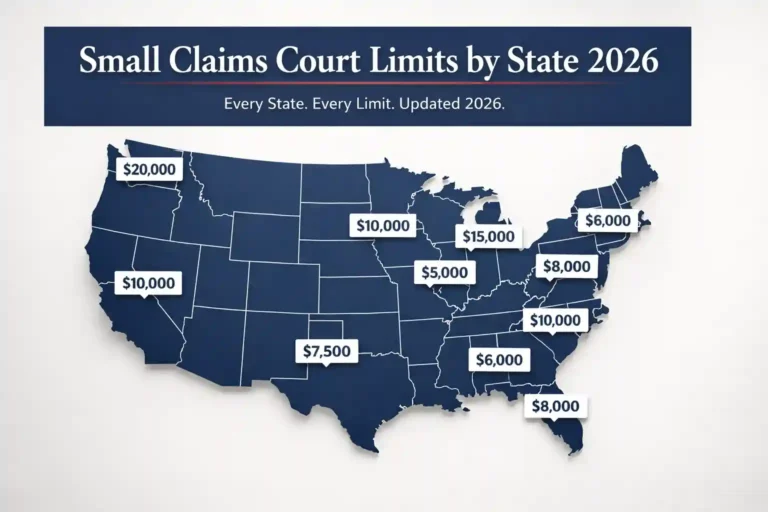
Small claims court is built for regular people to resolve disputes quickly and cheaply, often without a lawyer. Each state sets its own dollar limit:
|
State |
Small Claims Limit |
Court Name |
|---|---|---|
|
California |
$12,500 |
Small Claims Court |
|
Texas |
$20,000 |
Justice Court |
|
Florida |
$8,000 |
Small Claims Court |
|
New York |
$10,000 |
Small Claims Court |
|
Pennsylvania |
$12,000 |
Magisterial District Court |
|
Michigan |
$7,000 |
Small Claims Division |
|
Ohio |
$6,000 |
Small Claims Court |
Civil Court – For Larger or Complex Cases
Civil court handles bigger claims and complex legal disputes. It typically requires more preparation and often a lawyer. Use it for personal injury, major contract breaches, defamation lawsuits, fraud, and claims above the small claims limit.
Federal Court – Rarely Needed
Federal courts handle federal law violations or disputes between residents of different states involving more than $75,000. Most everyday lawsuits do not belong here.
How Much Does It Cost to Sue Someone?
Costs vary widely depending on the court, case complexity, and whether you hire a lawyer.
|
Expense |
Typical Cost |
Notes |
|---|---|---|
|
Small claims filing fee |
$30 – $100 |
Varies by state and amount claimed |
|
Civil court filing fee |
$100 – $400+ |
Depends on claim amount and jurisdiction |
|
Service of process |
$50 – $150 |
Required to officially notify defendant |
|
Attorney fees (hourly) |
$150 – $500/hr |
Varies by location and case type |
|
Attorney fees (contingency) |
25% – 40% of award |
Common for personal injury – no upfront cost |
|
Expert witnesses |
$500 – $5,000+ |
Needed for medical and technical cases |
|
Mediation |
$100 – $300/hr |
Usually split between both parties |
How Old Do You Have to Be to Sue Someone?
You must be 18 years old to file a lawsuit on your own in the United States. If you are under 18, a parent or legal guardian must file on your behalf as your “next friend” or guardian ad litem. The minor’s name appears on the case, but the adult manages all legal proceedings.
The statute of limitations is typically paused (“tolled”) for minors until they turn 18. This means if you were harmed as a child, you may still have time to sue even years later. Emancipated minors may be able to sue independently in some states.
How Long Do You Have to Sue Someone?
Every lawsuit has a legal deadline called the statute of limitations. Miss it and your case is almost certainly dismissed, no matter how valid your claim is.
|
Type of Claim |
Typical Deadline |
Notes |
|---|---|---|
|
Personal injury |
2 – 3 years |
CA and TX: 2 yrs; FL: 2 yrs (reduced from 4 in 2023) |
|
Car accident / auto injury |
2 – 3 years |
Varies by state |
|
Defamation / slander / libel |
1 – 3 years |
NY, CA, TX: 1 year – act fast |
|
Breach of written contract |
4 – 6 years |
CA: 4 yrs; TX: 4 yrs; NY: 6 yrs |
|
Fraud |
3 – 6 years |
Clock may start when fraud was discovered |
|
Assault / battery |
1 – 3 years |
Varies significantly by state |
|
Property damage |
3 – 5 years |
Depends on state |
|
Workplace harassment |
180 – 300 days |
Must file EEOC complaint first |
Warning: Do not wait. If you are unsure whether the deadline has passed, consult an attorney immediately. Courts almost never grant exceptions to the statute of limitations.
How to Sue Someone in Small Claims Court (Step by Step)
Small claims court is the most accessible legal option for most people. No law degree required. For the full small claims walkthrough with interactive steps and free resources:
- Confirm Your Case Qualifies. Your claim must be under your state’s small claims dollar limit, you must have a valid legal reason to sue, and you must be within the statute of limitations.
- Send a Demand Letter First. Before filing, send a written demand letter. State what you want, why you are owed it, and give a 7 to 14 day deadline to respond. Keep a copy – courts may ask for it.
- Find the Right Court. File in the county or district where the defendant lives or works, or where the dispute occurred. Search “[your state] small claims court” to find local information and forms.
- Complete the Claim Form. Get the form from the courthouse clerk or the court’s website. You will need your name and address, the defendant’s full legal name and address, the dollar amount claimed, and a brief reason for your claim. Use the defendant’s correct legal name – errors can delay or dismiss your case.
- File Your Claim and Pay the Fee. Submit your forms to the clerk and pay the filing fee ($30 to $100). If you cannot afford it, ask for a fee waiver application. Keep copies of everything.
- Serve the Defendant. The defendant must be officially notified – this is called “service of process.” In most small claims courts, the court mails notice by certified mail. In some states, you arrange service yourself through a sheriff or process server.
- Prepare Your Evidence. Gather contracts, invoices, receipts, text messages, emails, and photos. Make three copies: one for you, one for the defendant, one for the judge. Prepare a clear, brief explanation of what happened and what you want.
- Attend Your Hearing. Arrive early. Dress professionally. Address the judge as “Your Honor.” Calmly present the facts, show your evidence, and state what you want. Do not interrupt the other party.
- Receive the Judgment. The judge may rule immediately or mail a written decision. If you win, you receive a judgment – a court order that the defendant owes you money. If you lose, you generally have 30 days to appeal.
- Collect Your Money. Winning is step one. To actually collect, you may need wage garnishment, a bank levy, or a property lien.
What if you do not know their address? Check public records (property records, business registrations), hire a licensed process server, or consult an attorney. Courts cannot serve a defendant without an address.
How to Sue Someone in Civil Court (Step by Step)
Civil court handles larger, more complex cases. The process is more formal than small claims court and a lawyer is strongly recommended.
Special Case Types: Defamation, Harassment, Car Accidents and More
Some lawsuits are more complicated than others because the type of claim determines everything from where you file to how long you have to act. Defamation, harassment, and car accidents all follow different rules, and mixing them up can cost you your case. This section breaks down the most common special case types and what you need to know before moving forward.
For Defamation of Character (Slander and Libel)
Slander is spoken false statements. Libel is written or published false statements, including social media posts. To win a defamation lawsuit, you must prove:
Note: Opinions are not defamation. “I think Jane is unreliable” is an opinion. “Jane embezzled from her employer” is a statement of fact and could be defamation if false and harmful.
For Emotional Distress
There are two types:
These are hard to win alone and are usually paired with other claims. Documentation from a therapist or psychiatrist strengthens these cases significantly.
For Harassment
For a civil harassment lawsuit you generally need to show a pattern of unwanted, targeted conduct that caused measurable harm. Many victims first seek a restraining order or protective order, which is faster than a full lawsuit. Workplace harassment requires an EEOC complaint before suing.
For Breach of Contract
You must prove:
Written contracts are far easier to enforce than oral ones. Texts and emails confirming an oral agreement are critical evidence.
After a Car Accident
For Fraud
Prove: a false statement of material fact, the defendant knew it was false, you reasonably relied on it, and you suffered measurable financial harm. Fraud can also be reported to the FTC or FBI’s Internet Crime Complaint Center (IC3) for criminal investigation.
For Assault
In civil law, assault is placing someone in reasonable fear of imminent harmful contact. You do not need a criminal conviction first – the civil standard of proof is lower. Collect police reports, medical records, photos, and witness statements. Statute of limitations: 1 to 3 years depending on your state.
For False Accusations
If someone made false allegations that damaged your reputation, you may have a defamation or malicious prosecution claim. You generally need to show the accusation was made with malice and without probable cause, and that it caused you harm.
For Pain and Suffering
Pain and suffering damages are available in personal injury cases. They are added on top of medical expenses and lost wages – not a standalone claim. An attorney can help you calculate a fair amount based on the severity and duration of your suffering.
For Property Damage
You will need photos or video of the damage, repair estimates or receipts from licensed contractors, evidence linking the defendant to the damage, and documentation of the property’s value before the damage. Property damage claims are well-suited for small claims court if the amount is within your state’s limit.
How to Sue Someone Who Owes You Money
Unpaid debts are the most common reason people sue. Whether it is an unpaid loan, bounced check, unfulfilled freelance work, or a broken business deal, here is how to approach it.
For Amounts Under the Small Claims Limit
For Larger Amounts
Consider hiring a collections attorney (many work on contingency for debt cases) and file in civil court with a formal complaint. You may also sell the debt to a collections agency, though you will receive less than the full balance.
Are they judgment-proof? Before suing, assess whether the person can actually pay. A judgment you cannot collect is still on record for years and can be revived, but it may not be worth your time right now.
How to Sue Someone in Another State or Country
When the person or business you need to sue is not in your state or not even in your country the process becomes more complicated, but it is not impossible. Where you file, and whether a court can legally hear your case, depends on a set of rules called jurisdiction.
Suing Someone in a Different State
You can sue an out-of-state defendant, but the court must have jurisdiction over them. Your state’s court likely has jurisdiction if:
You can also file in the defendant’s home state. Judgments can be enforced across state lines under the Constitution’s full faith and credit clause.
Suing Someone in Another Country
International lawsuits are complex and often impractical. Each country has its own legal system and the U.S. has no automatic treaty for recognizing foreign judgments with most nations. For online scams involving foreign nationals, consider reporting to the FBI’s IC3 or Interpol. Consult an attorney who specializes in international law.
How to Sue Without a Lawyer or Without Money
You do not need to be rich or have a law degree to take someone to court. Many courts are set up to handle cases filed by everyday people, and there are free tools, resources, and programs available to help you every step of the way. Knowing where to look makes all the difference.
Representing Yourself (Pro Se)
Representing yourself in court is called “pro se.” It is your legal right in all U.S. courts and is most practical in small claims court, where lawyers are often not even allowed.
How to Sue Someone for Free or Low Cost
Small Claims Limits and Statutes of Limitations by State
|
State |
Small Claims Limit |
Personal Injury |
Written Contracts |
Notes |
|---|---|---|---|---|
|
Texas |
$20,000 |
2 years |
4 years |
Attorney fees recoverable in many contract cases |
|
California |
$12,500 |
2 years |
4 years |
Defamation: 1 year. Self-help resources at selfhelp.courts.ca.gov |
|
Florida |
$8,000 |
2 years |
5 years |
No-fault auto state. File PIP claim first after accidents |
|
Pennsylvania |
$12,000 |
2 years |
4 years |
Service of process handled through the sheriff’s office |
|
Michigan |
$7,000 |
3 years |
— |
No-fault auto state |
|
Ohio |
$6,000 |
2 years |
6 years |
Attorneys allowed in small claims court, unlike most states |
|
New York |
$10,000 |
3 years |
6 years |
Defamation: 1 year. NYC has its own separate small claims process |
What Happens After You Win?
Winning in court is a great first step – but a small claims judgment is not a check. Here is how to actually collect your money:
Judgments remain on record for 10 to 20 years depending on the state and can be renewed. The defendant’s credit score is also negatively impacted. If they refuse to cooperate, you can return to court and have them held in contempt.
How to Counter-Sue Someone
If you have been sued and you also have a valid claim against the plaintiff, file a counterclaim. In civil court, this goes in your Answer. In small claims court, you typically file a separate counterclaim form at or before the hearing. Both claims are resolved at the same time, saving everyone money and time.
Conclusion
The U.S. legal system was created so that ordinary people, not just those who can afford expensive attorneys, can pursue justice. Whether you are trying to recover a few hundred dollars or dealing with a more serious dispute, the courts provide a structured way to resolve conflicts and protect your rights.
One of the most effective first steps in any dispute is sending a demand letter. A simple written request asking the other party to resolve the issue often encourages a settlement before legal action becomes necessary. Many disagreements are resolved at this stage, saving both time and money. It is also important to pay close attention to legal deadlines.
Every claim is governed by a statute of limitations, which sets the maximum amount of time you have to file a case. Missing this deadline can permanently prevent you from pursuing your claim, so acting promptly is essential. Choosing the appropriate court can make the process much easier. For smaller disputes, small claims court is usually the most practical option because it is designed to be faster, less expensive, and easier for individuals who represent themselves.
As soon as a dispute arises, gathering and preserving evidence should become a priority. Emails, text messages, contracts, invoices, photos, and receipts can all play a crucial role in proving your case. Saving these materials early ensures that important information is not lost or deleted over time. While many cases can be handled without an attorney, professional legal advice can still be valuable. Even a brief consultation with a qualified lawyer can help clarify your rights, strengthen your strategy, and prevent costly mistakes.
Finally, remember that winning a case is only part of the process. Before investing time and effort in a lawsuit, it is wise to consider whether the person or business you are suing has assets or income that can actually be used to satisfy a court judgment. Legal disputes can feel overwhelming, but with preparation, organization, and a clear understanding of the process, navigating the legal system becomes much more manageable.
Many people successfully represent themselves in court every day.
This article is provided for general informational purposes only and should not be considered legal advice. Laws and procedures vary by state and jurisdiction, so consulting a licensed attorney is recommended for guidance related to your specific situation.
Frequently Asked Questions
Sources and References
- uscourts.gov: Federal court procedures and jurisdiction rules: https://www.uscourts.gov/courts/federal-courts
- courts.ca.gov/selfhelp: California self-help court resources: https://www.courts.ca.gov/selfhelp.htm
- txcourts.gov: Texas Justice Court rules: https://www.txcourts.gov/justicecourts
- flcourts.gov: Florida small claims procedures: https://www.flcourts.gov/Resources-Services/Court-Improvement/Family-Courts/Small-Claims
- nycourts.gov: New York court system: https://www.nycourts.gov/courthelp/SmallClaims
- justia.com: State-by-state statute of limitations summaries: https://www.justia.com/statutes-of-limitations
- law.cornell.edu: Definitions and legal standards including preponderance of evidence, service of process, and default judgment: https://www.law.cornell.edu/wex
- ftc.gov: Consumer protection and demand letter guidance for fraud cases: https://www.ftc.gov/consumers
- ftc.gov/reportfraud: Consumer fraud complaints: https://reportfraud.ftc.gov
- adr.org: Arbitration and mediation standards: https://www.adr.org
- lawhelp.org: Free legal help by state: https://www.lawhelp.org
- lsc.gov: Federal legal aid program: https://www.lsc.gov/about-lsc/what-legal-aid
- americanbar.org: Bar association referral services and pro se guidance: https://www.americanbar.org/groups/legal_services/flh-home
- eeoc.gov: Filing requirements before suing for workplace harassment: https://www.eeoc.gov/filing-charge-discrimination
- ic3.gov: Online fraud reporting: https://www.ic3.gov
- iii.org: No-fault state rules for Florida, Michigan, and New York: https://www.iii.org/article/no-fault-auto-insurance
- usmarshals.gov: Service of process rules for federal cases: https://www.usmarshals.gov/what-we-do/judicial-security/service-of-process
- consumerfinance.gov: Debt collection and unpaid money disputes: https://www.consumerfinance.gov/consumer-tools/debt-collection
- hg.org: General legal encyclopedia for breach of contract and fraud definitions: https://www.hg.org/breach-of-contract.html
- nolo.com: Small claims procedures and self-representation guidance: https://www.nolo.com/legal-encyclopedia/small-claims-court
- supremecourt.gov: Full faith and credit clause for out-of-state judgment enforcement: https://www.supremecourt.gov
- interpol.int: International lawsuit and cross-border fraud reporting: https://www.interpol.int/Crimes/Financial-crime
- dol.gov: Workplace harassment and wage disputes before suing an employer: https://www.dol.gov/agencies/whd/workers